
Rule of Thumb
If your garage door won't budge on a cold morning, the odds are high that it's frozen to the slab at the bottom seal — not a broken part. That's the most common culprit after a hard freeze or a nor'easter that leaves slush on the driveway overnight. But there are real exceptions: cold metal contracts, so a spring that was already weak can finally give out on a 15-degree morning, and an opener that's been straining against ice for weeks can drift out of adjustment. Knowing which one you've got saves you from either forcing a frozen door (which can bend track or tear the bottom panel) or ignoring a mechanical issue that's just getting worse.
Symptoms to Notice First
- Door won't move at all — opener motor hums or clicks but the door stays put.
- Door lifts an inch or two, then stops or reverses — often the opener's safety system reacting to resistance.
- Visible ice or a frost line along the bottom edge where the weatherstripping meets the concrete.
- Sluggish, jerky, or noisy movement even once the door does start moving.
- Remote works inconsistently, or the opener's light blinks without the door responding.
- Door reverses right after the photo-eye sensors, even with nothing in the way.
Match what you're seeing against the list below — it's roughly the order a technician would check things, simplest and most likely first.
1. Ice Fused at the Bottom Seal
This is the first thing to rule out, and it's the easiest to fix yourself. Freeze-thaw cycles are routine around here — a 40-degree afternoon melts snow on the apron, then it refreezes overnight and bonds the rubber seal to the concrete. The fix: pour warm (not boiling) water along the seal, or run a hair dryer along the base, then try the opener again. Don't pry the door with a shovel or chip at the ice with a metal tool — that cracks the weatherstripping and can bend the bottom panel, turning a five-minute problem into a repair.
2. Thickened Lubricant on Tracks and Rollers
Cold weather thickens grease, and old or dried-out lubricant gets even stiffer. If the door moves but feels gritty, jerky, or louder than usual, this is usually next. The fix is a light coat of silicone-based garage door lubricant on the rollers, hinges, and track — not WD-40, which is a solvent and actually strips lubrication over time. This is reasonable maintenance for a homeowner to do once or twice a year, and late fall before the first hard freeze is the right time.
3. Spring Tension Lost to the Cold
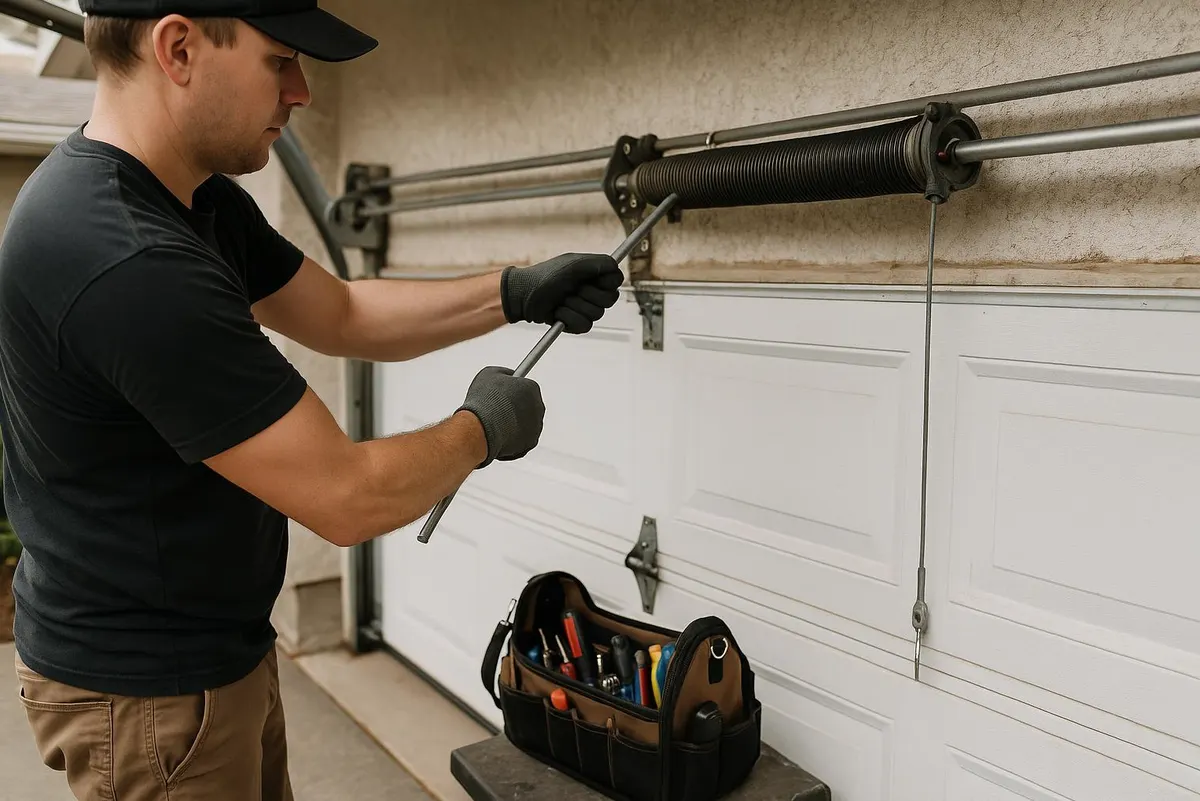
Steel springs contract slightly in cold temperatures, which changes the tension they're under. A spring that was already near the end of its lifespan — original to an older house, showing gaps between coils, or visibly stretched — is far more likely to finally snap on a cold morning than in July. Symptoms here include the door feeling unusually heavy when lifted manually, or the opener straining audibly before the door moves. Torsion springs are under enough stored tension to cause serious injury if handled incorrectly, so this is not a DIY fix — it's a job for a technician with the right winding bars and clamps.
4. Opener Force and Limit Settings Out of Sync
If the door stops partway or reverses without obstruction, the opener's travel limits and force settings may no longer match how the door is actually moving in the cold. Garage doors contract slightly in freezing temperatures, and an opener calibrated in warmer months can misread that as resistance and trigger its safety reversal. A technician resets the limit and force settings to match the door's current behavior — a quick adjustment, but one that requires testing the door through a full cycle to get right.
5. Photo-Eye Sensors Clouded or Misaligned
The safety sensors near the bottom of the tracks are sensitive to condensation and frost. A foggy or frozen lens can make the opener think something's blocking the door even when nothing is. Wiping the lenses with a dry cloth and confirming both sensors are aimed directly at each other (the indicator lights should be solid, not blinking) solves this in most cases. If the bracket has been bumped or has shifted over time, realignment is a quick fix.
6. Worn Weatherstripping
Cracked or brittle bottom seals let in moisture that then freezes solid overnight, which is part of why older seals cause recurring ice problems in the first place. Replacing the bottom seal is inexpensive and cuts down on both the ice-fusion issue and drafts into the garage — a reasonable fix before the coldest stretch of winter sets in.
7. Aging Hardware on an Original Door
A lot of homes around Medford still have their original garage door, and decades of use plus winter salt and moisture take a toll on hinges, rollers, and track alignment. Rust at the hinges, a track that's pulled slightly away from the frame, or a panel with visible warping all make cold-weather sticking worse and are harder to fully resolve with lubrication alone. At this point it's a question of whether repair still makes sense or whether the door and hardware are due for replacement.
When to Call Medford Garage Door
If warm water and fresh lubricant don't solve it, or if you're hearing straining, grinding, or seeing an uneven lift, it's time to call. We handle spring replacement for doors showing cold-weather strain before they fail completely, and garage door repair for openers that need their limits and force settings reset for winter. We'll also check weatherstripping and hardware condition while we're there, since one often explains the other.
If your garage door is giving you trouble this winter, call Medford Garage Door — local, on time, and ready to get it moving again before the next cold snap hits Medford, NJ.